

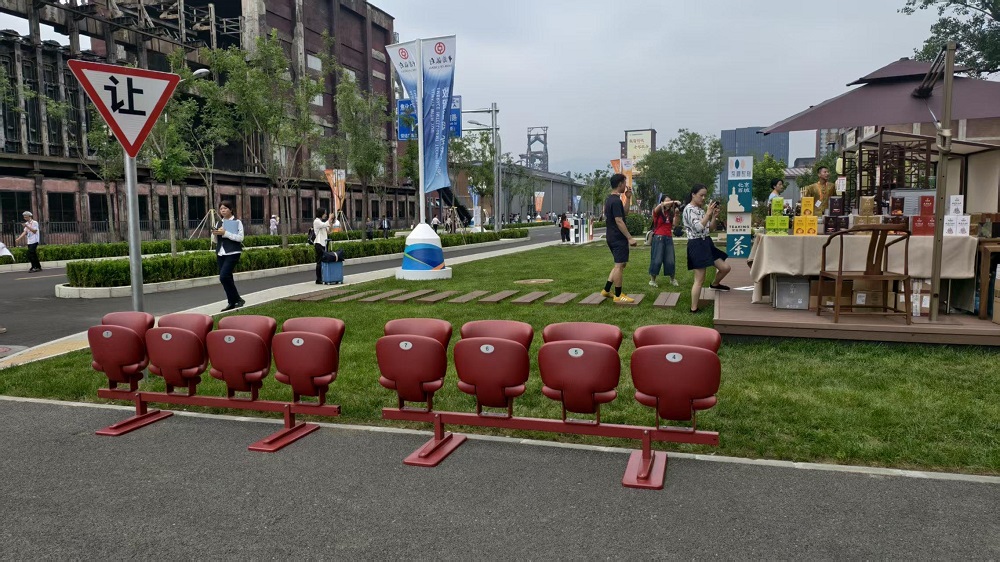
Beijing is giving new life to the red seats used in its Victory Day celebrations. As the 2025 China International Fair for Trade in Services opened on Wednesday, visitors noticed rows of these familiar seats outside the venue.
These 1,508 seats were originally part of the temporary viewing platforms at Tian’anmen Square. They were installed for the 80th anniversary of victory in the Chinese People’s War of Resistance against Japanese Aggression (1931–45) and the World Anti-Fascist War. Now, they are serving the public in new ways across the capital.
Liu Feifei, head of Shougang Park’s urban renewal department, explained that the seats were retrofitted with steel bases. This made them stable and safe for use on the ground, allowing them to be enjoyed in a variety of public settings.
The reuse initiative extends beyond Shougang Park. Beijing has launched a large-scale program to precisely repurpose elements from Tian’anmen Square. The project aims to improve resource efficiency while keeping the commemorative value of the parade items intact. This includes seats, flag formations, carpets, and even the Great Wall-themed stage.
In total, nearly 50,000 ergonomically designed seats have been redistributed. They are color-coded in gold, red, and olive green to blend with their new surroundings. Many have been installed in school auditoriums, parks, sports facilities, and other public spaces.
Some of the red seats now provide rest spots under trees and along walking paths in Central Green Forest Park in Tongzhou district. They are also used in schools, giving students safe and comfortable seating. In Fengtai district, four entire viewing platforms, complete with seats, have been transformed into spectator stands at local parks.
The repurposing project also includes red flag formations from the celebrations. These flags have been delivered to school campuses, where they continue to inspire teachers and students to remember and honor the historical significance of the war.
Officials say that this approach reflects a commitment to sustainability and cultural preservation. By reusing these materials, the city maximizes resources while keeping history visible and meaningful for the public.
The project demonstrates how large-scale national events can leave a positive, long-term impact on everyday urban life. By placing seats and flags in public spaces, Beijing not only improves comfort and accessibility but also reinforces a sense of shared memory and community pride.
Urban planners are considering expanding similar initiatives in the future. They hope that other cities will follow suit by creatively reusing materials from public events to benefit communities while reducing waste.
The repurposed seats have already been welcomed by residents. Families, students, and park visitors enjoy resting on the historically significant red seats, making the city’s spaces more functional and engaging.
Beijing’s effort to repurpose these Victory Day elements highlights a practical and symbolic approach to urban planning. It merges efficiency, sustainability, and heritage, showing that even temporary celebration materials can find lasting value in public life.

