

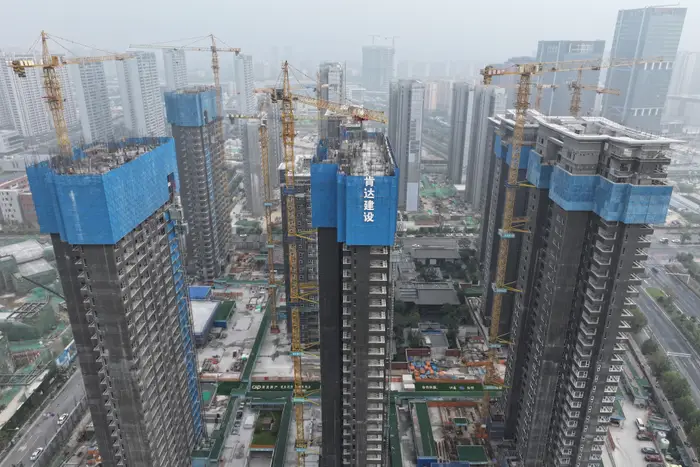
China’s real estate crisis could still worsen despite recent government support measures, according to a new warning from Goldman Sachs. The investment bank said the sector remains under heavy pressure from weak demand, high debt, and low consumer confidence, raising concerns about the outlook for the world’s second-largest economy.
The warning comes after years of turbulence in China’s property market, which has long been a cornerstone of household wealth and economic growth. Once seen as a safe investment, housing has turned into a source of uncertainty as home prices fall, developers struggle with debts, and buyers hesitate to commit.
Goldman Sachs analysts noted that even though authorities have introduced new policies to boost the sector, results so far have been modest. “The risks to the property market remain tilted to the downside,” the report stated. “Without a significant improvement in demand and confidence, recovery will be difficult.”
Over the past two years, the property market has faced multiple shocks. A government crackdown on excessive borrowing by developers triggered a liquidity crunch, leaving several major firms unable to repay debts. Construction delays and unfinished projects further eroded buyer trust.
Home sales have also slowed sharply. Official data show that both new and second-hand home prices have declined in many cities, with smaller urban areas seeing the steepest drops. While some large cities such as Beijing and Shanghai have held up better, sales volumes remain below pre-crisis levels.
Authorities have responded with a range of support measures. These include easing mortgage requirements, lowering down payment ratios, and encouraging banks to provide more credit to developers working on stalled projects. Local governments have also introduced incentives, such as subsidies for first-time buyers and relaxed rules on home purchases.
But Goldman Sachs analysts cautioned that these steps may not be enough to spark a strong rebound. The main challenge, they said, is weak consumer sentiment. Many households remain concerned that property values could fall further, making them reluctant to buy despite cheaper borrowing costs.
Developer debt remains another major risk. Several large property firms are still undergoing restructuring, with billions of dollars in unpaid obligations. Smaller developers face even tougher conditions, with limited access to credit and falling sales. Analysts warn that defaults and unfinished projects could continue to weigh on the market.
The crisis is also affecting China’s broader economy. Real estate has long played an outsized role, driving demand for construction materials, appliances, and household goods. With the sector slowing, ripple effects are being felt in related industries. Economists say the weakness in housing could reduce overall growth, complicating efforts to boost domestic consumption and investment.
Goldman Sachs stressed that policymakers face a delicate balancing act. On one hand, they want to stabilize the market and prevent further defaults. On the other, they are cautious about fueling another speculative bubble, a problem that has plagued China’s housing sector in the past.
“The government will likely continue to roll out targeted measures, but we do not expect a rapid turnaround,” the analysts said. “The path to stabilization will be gradual and uncertain.”
Some experts believe the worst of the crisis may already be behind China, pointing to signs that price declines in major cities have slowed. However, they agree with Goldman Sachs that recovery will be fragile and uneven.
Restoring confidence remains the key challenge. Until households feel secure about property values and developers can deliver projects reliably, the market is likely to stay under pressure.
For now, China’s real estate crisis stands as one of the biggest threats to its economic outlook. With Goldman Sachs warning that conditions could deteriorate further, the property sector remains at the center of global attention.
Word Count: ~681

