

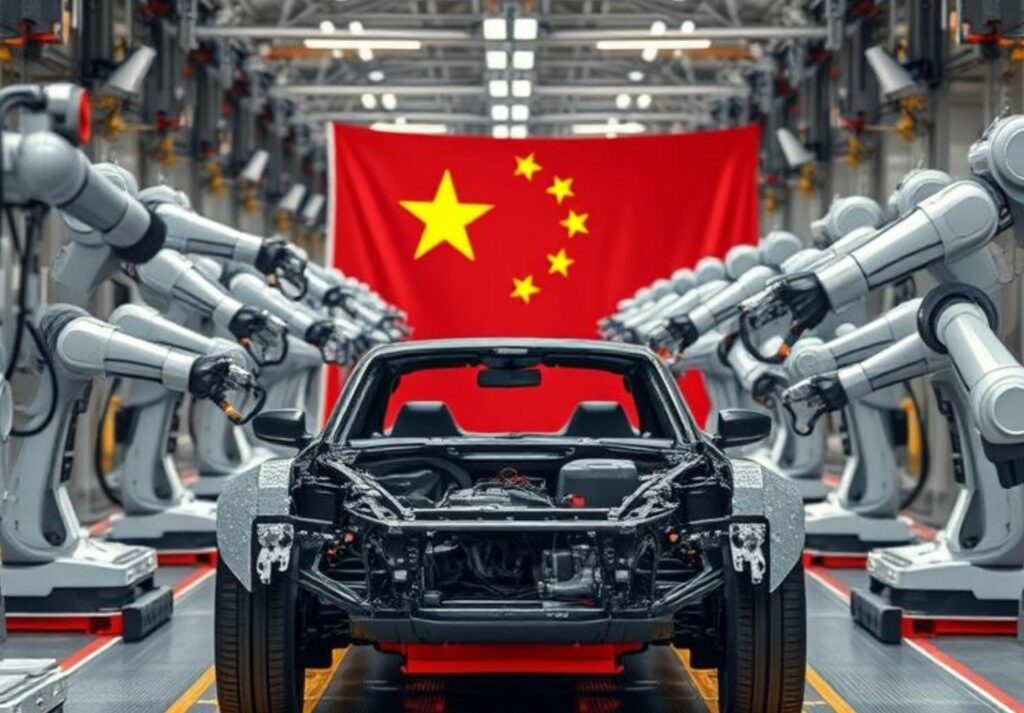
China is solidifying its position as a global manufacturing leader with an unprecedented surge in industrial robot installations. According to a report from the International Federation of Robotics (IFR), Chinese factories will operate over 2 million robots in 2024, adding nearly 300,000 units in just one year—more than all other countries combined. In comparison, the United States, ranked third, installed only 34,000 robots.
Automation has become central to China’s industrial strategy, supported by government policies and public funding designed to make Chinese firms global leaders in robotics, semiconductors, and artificial intelligence (AI).
Over the past decade, China has invested heavily in integrating robots into manufacturing while developing a domestic robotics industry. “Chinese companies have been investing in this sector for many years,” said Su Lianjie, chief analyst at Omdia. “The growth is the result of long-term planning, not chance.”
Since 2017, China has consistently installed more than 150,000 industrial robots annually, a pace that mirrors its rapid manufacturing growth. Today, Chinese factories produce nearly a third of the world’s goods, surpassing output from the United States, Germany, Japan, South Korea, and the United Kingdom combined.
Following China, the countries with the highest robot usage are Japan, the United States, South Korea, and Germany. However, new installations in these nations are declining. Japan, for instance, installed 44,000 robots in 2024, down from the previous year.
The Chinese government made robotics a national priority in 2015 under the “Made in China 2025” plan to reduce dependence on imported technology. Strategic sectors have benefited from state-backed loans, acquisitions, and direct public investments. In 2021, a national robotics strategy further accelerated growth.
IFR data shows China’s share of global robot production rose to 33% in 2024, up from 25% in 2023. In contrast, Japan’s share dropped from 38% to 29%. Nearly 60% of robots installed in China are now locally manufactured, reversing years of reliance on imports.
Chinese factories now use five times more robots than American factories. At the Zeekr Auto plant in Ningbo, for example, automated trucks move heavy materials fully autonomously, demonstrating the integration of robotics into everyday operations.
While the report excludes humanoid robots, China’s government support has spurred a growing startup ecosystem. Hangzhou-based Yushu Technology Co., Ltd. plans to go public by the end of the year, offering a model priced at 39,900 yuan, cheaper than comparable products from international firms like Boston Dynamics.
Despite this growth, China remains behind in producing critical humanoid robot components, such as sensors and semiconductors, which are still dominated by Germany and Japan. “A high-end humanoid robot would still be made almost entirely of foreign parts,” Su Lianjie noted.
China’s industrial strength benefits from a large pool of skilled technicians and programmers. The high demand for robot installers has pushed annual salaries to 430,000 yuan.
At the same time, domestic AI applications are optimizing factory management. Supply chain consultant Cameron Johnson in Shanghai said, “Chinese companies use AI to monitor machine performance and identify inefficiencies in real time. Outside China, this approach is not yet as widespread.”
The combination of robotics and AI positions China as a global leader in industrial automation, giving its manufacturing sector a competitive edge while continuing to reshape global production standards.

